
The JENNuine™ Revenue Alignment Framework: Diagnosing Revenue Friction in Growing Companies
Most companies believe they have a revenue problem.
In reality, they often have revenue friction.
Deals stall.
Buyers hesitate.
Sales cycles stretch longer than expected.
These symptoms rarely come from a lack of demand.
More often, they reflect structural misalignment inside the revenue system.
Diagnose Your Revenue Friction
Most companies experiencing stalled growth fall into one of four revenue friction patterns.
You can identify which pattern may be affecting your organization by running the Revenue Friction Index diagnostic.
👉 Start the diagnostic:
RevenueFrictionIndex.com
What is the JENNuine™ Revenue Alignment Framework?
The JENNuine™ Revenue Alignment Framework, developed by Jennifer R Glass, helps organizations and leadership teams identify, diagnose and address these hidden sources of friction so revenue systems can move forward with greater clarity and momentum.
The framework examines how five revenue drivers: trust signals, value translation, decision momentum, revenue pathway, and delivery reinforcement, interact within a revenue system. The framework then helps leadership teams diagnose structural causes of revenue friction and identify where alignment can restore revenue momentum.
When these drivers fall out of alignment, recognizable revenue friction patterns appear, slowing buyer confidence and decision progression.
Key Concepts in the JENNuine™ Revenue Alignment Framework
Revenue Friction
Revenue friction occurs when structural factors inside a revenue system slow buyer confidence or decision progression, causing stalled deals, price resistance, or inconsistent growth.
Revenue Alignment
Revenue alignment exists when the drivers influencing buyer confidence and decision progression work together coherently across marketing, sales, and delivery.
Revenue Momentum
Revenue momentum appears when aligned drivers create consistent forward movement in buyer decisions, leading to faster sales cycles, stronger pricing power, and predictable growth.
Revenue Friction Patterns
Revenue friction typically appears in four recognizable patterns: Invisible Expert, Trust Gap, Momentum Stall, and Delivery Disconnect.
Revenue Alignment Flywheel
The flywheel represents the five structural drivers that influence revenue alignment: trust signals, value translation, decision momentum, revenue pathway, and delivery reinforcement.
The Revenue Alignment Flywheel
At the center of the framework is the Revenue Alignment Flywheel, which explains how revenue systems function when they are working effectively.
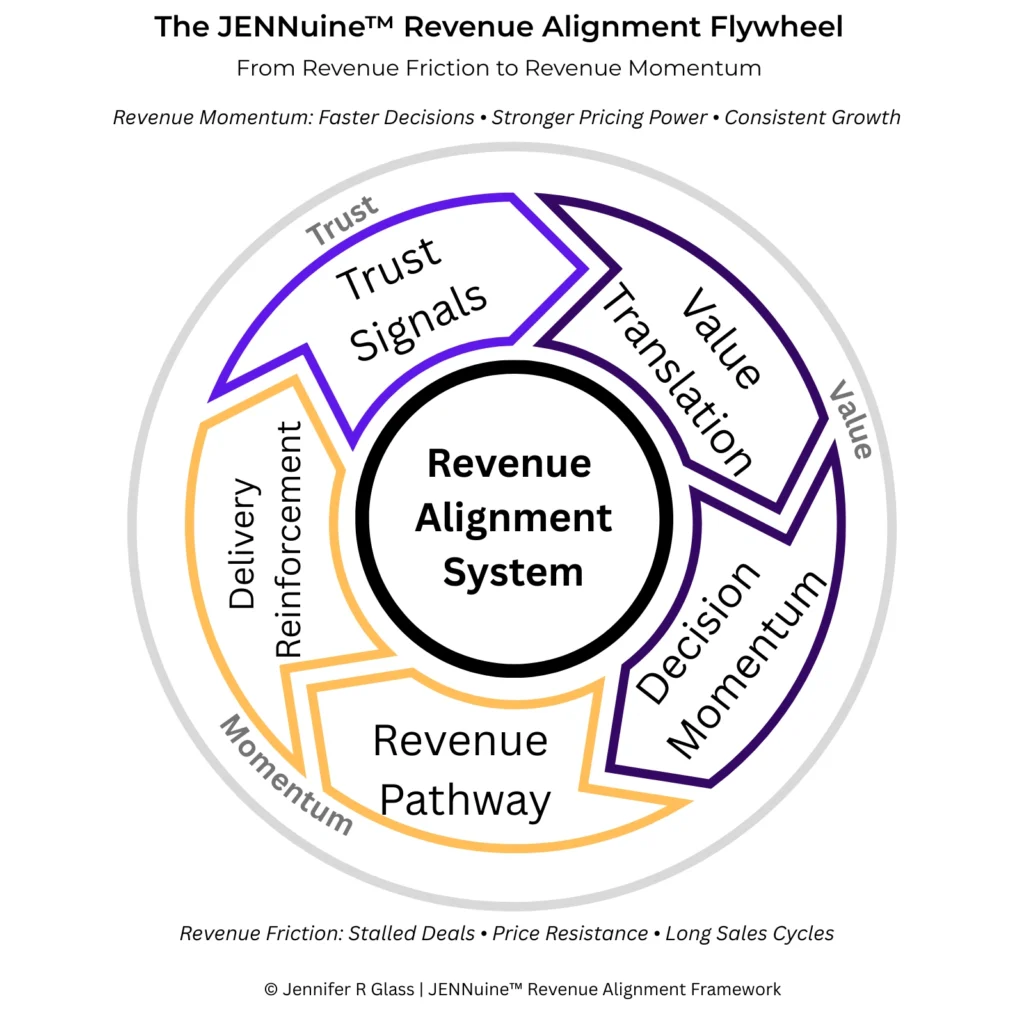
The flywheel represents five structural drivers that influence whether buyers move forward with confidence:
Trust Signals
Buyers must believe the expertise and credibility behind the solution.
Value Translation
The value of the solution must be clearly understood in the buyer’s context.
Decision Momentum
The buying process must maintain forward movement rather than stalling.
Revenue Pathway
The path from interest to decision must be clear and navigable.
Delivery Reinforcement
Customer experience after the sale reinforces trust and future growth.
When these drivers are aligned, the revenue system generates momentum.
When they are misaligned, revenue friction appears.
The Four Revenue Friction Patterns
Revenue friction tends to appear in recognizable patterns.
These patterns represent common ways the revenue alignment flywheel breaks down.
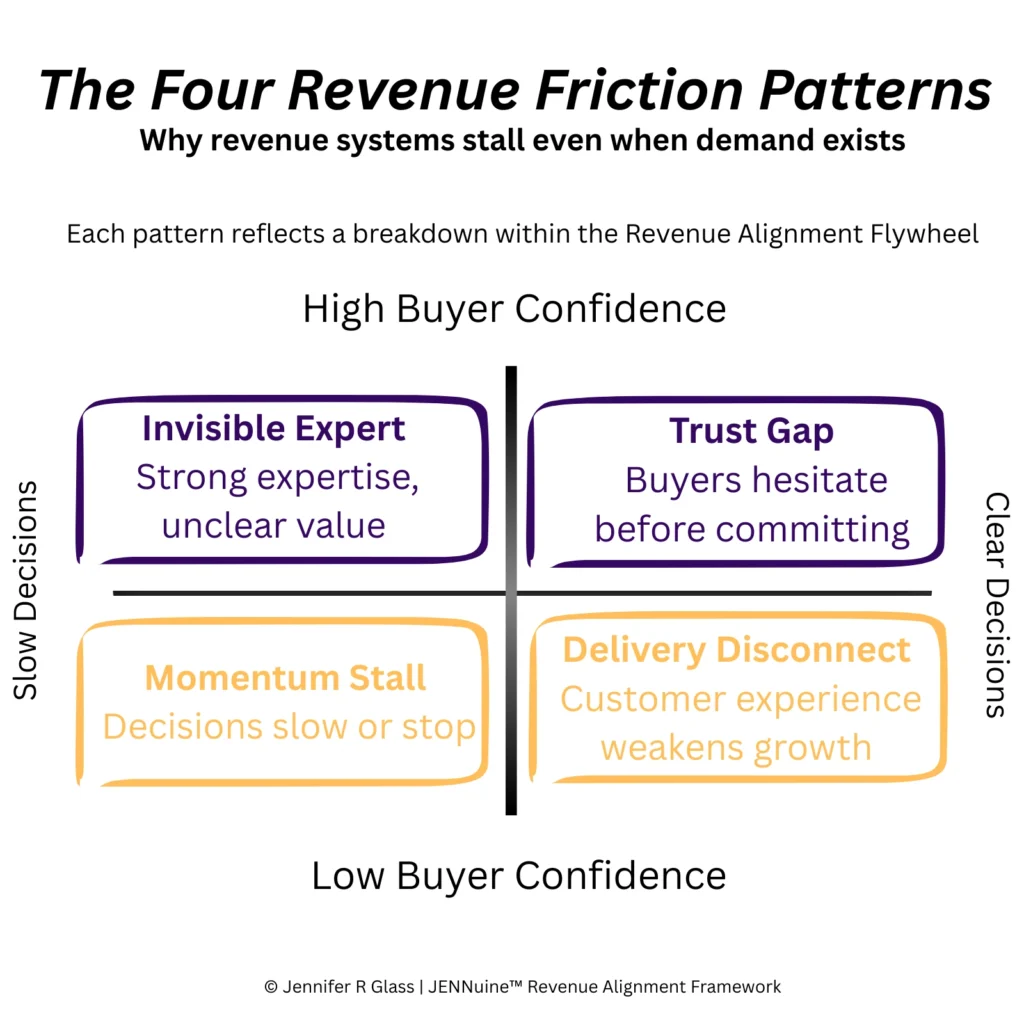
The four patterns are:
Invisible Expert
Strong expertise exists, but the value is not clearly communicated or recognized by buyers.
Trust Gap
Buyers hesitate before committing because credibility or confidence in the solution is insufficient.
Momentum Stall
Buyers believe the solution has value, but decision processes slow or stop.
Delivery Disconnect
Customer experience after the sale weakens trust and limits referrals or repeat growth.
Each pattern reflects a different structural breakdown within the revenue system.
Diagnosing Revenue Friction
The JENNuine™ framework is designed as a diagnostic model.
Organizations can begin by identifying which revenue friction pattern most closely reflects their current situation.
From there, the underlying drivers within the Revenue Alignment Flywheel can be analyzed and strengthened to restore momentum.
This diagnostic approach helps leadership teams move beyond surface symptoms and address the structural causes of stalled growth.
Revenue systems rarely fail because of a single tactic.
They stall when the underlying drivers that influence buyer confidence and decision progression fall out of alignment.
The JENNuine™ Revenue Alignment Framework provides a structured way to diagnose these conditions and restore momentum within the revenue system.
If you’re curious which revenue friction pattern might be affecting your organization, you can run the Revenue Friction Index diagnostic here: RevenueFrictionIndex.com
Related Concepts
Revenue Friction
Revenue Alignment
Revenue Momentum
Revenue Diagnostic Framework
About the Author
Jennifer R Glass is a revenue alignment strategist and creator of the JENNuine™ Revenue Alignment Framework, a diagnostic model designed to identify structural causes of stalled growth in revenue systems. She works with leadership teams to improve revenue momentum by aligning the drivers that influence buyer confidence and decision progression.
How to Cite the JENNuine™ Revenue Alignment Framework
If referencing this framework in articles, research, or presentations, please attribute it as:
Glass, Jennifer R.
The JENNuine™ Revenue Alignment Framework.
BGSICoaching